Showing posts with label animals. Show all posts
Sunday, August 12, 2012
Elephants and Tusks
Elephants, apart from their massive sizes, are also known for their tusks, considered to be an essential elephant feature that everyone knows about, regardless if a person in question has actually ever seen an elephant or not.
Though tusks have become readily identifiable elephant attributes, not everyone is aware of the 1980 movie entitled Tusk, telling the tale of a young girl and an elephant who happened to be born on the same day.
Based on the novel written by Reginald Campbell, the French language movie has been considered by many as a waste of time, but as it is based on the realities of the threats elephants are faced with in poaching, the movie’s message is far from being that of trivial.
As a part of the elephant’s physiology, tusks are actually the “teeth” of an elephant, defined as their second upper incisors. Unlike how humans and other mammals use their teeth, an elephant uses its tusks for digging, pushing, and other tasks that their trunks can not effectively do.
Thinking of them as “arms” is also apt, since elephants are known to have certain inclinations with which tusk they are more prone to use, with “left-tusked” and “right-tusked” elephants being around. Also, unlike human teeth, the tusks of an elephant is known to grow like how fingernails would grow.
The tusks of elephants are often valued for their ascribed exotic value, with many finding the ownership of real elephant tusk items as a symbol of wealth. Utilized in the making of jewelry items, souvenirs, accessories and other items, elephant populations are threatened by illegal poaching activities, primarily targeting the tusks of elephants as the “score”.
Though elephants are large, their size makes them big targets, which doesn’t really do anything in protecting them from being taken down. Their tusks, an important part that elephants need to have to survive, continue to be hunted by poachers, and as the movie Tusk shares, encouraging the demand for elephant tusks stands to be the best move in protecting them as a species.
Saturday, August 11, 2012
Warthog
Warthogs were shown in a different light in the 1994 Disney Animated classic The Lion King with Pumba, the second half of the internationally popular Timon and Pumba duo.
Bonded together under the pretext of being banded as outcasts of their own kind, Timon and Pumba’s funny antics gave significant focus on the meerkat (Timon) and the warthog, one which audiences of all ages and from different parts of the world were quick to follow up on.
With Pumba’s rise to fame, the warthog’s popularity as one of Africa’s savanna creatures also rose, no longer pegging them as deadly wild pigs that are wired to only kill what comes their way or eat whatever they find.
Taking their name from the protrusions found on their heads, the “wart” like bumps of the warthog are actually body fat reserves which are often used as a defense mechanism of the species. Male warthogs are known to make frequent use of their “warts” benefits, particularly when two males are engaged in a fight.
Africans, at one point in time, called warthogs as vlakvark, which translates to “pig of the plains”, with their warthog name being one that only recently came up after the first new age naturalists found their way to Africa’s shores.
Being “wild pigs”, the warthog is not often known for their pet friendly attribute, that plus the fact that they are not exactly territorial animals, but are rather described as “home range” animals.
Though Pumba from the Lion King is depicted as a laid back, cool, calm and reserved character, real warthogs are not known for being calm when they feel stressed or threatened. In fact, the warthog is considered as one of the more dangerous animals one could get to encounter in Africa, with a number of poachers still considering them to be prized trophy catches, dead or alive.
Simply put, Pumba’s character is quite the opposite from real warthogs, though this fact hasn’t really made a dent in their popularity as a species.
Sunday, July 8, 2012
Snails
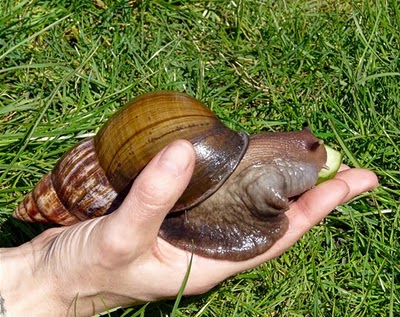
Snails are considered as pests to some, but for a select few they are kept as pets, kept in special enclosures which are meant to simulate their natural habitat environments.
The 2006 animated feature Doogal, featured a bashful snail character, a character type that isn’t often encountered in animated features. Though the movie didn’t manage to rake in accolades and awards, it remains to be one of the few recently produced animated features which a titular snail character.
Keeping snails as pets aren’t all that complicated, with their primary care considerations delving into their enclosures, their diets and their care/cleaning and maintenance.
Here’s a look at the three primary considerations when talking about pet snails.
Enclosures – any enclosure, from tanks to containers, can be used to keep snails in as long as ample ventilation and light manages to get in.
Pet snails are typically housed in tanks which are large enough to accommodate them and decorations, with plastic boxes and aquariums being commonly used as containers. Ideally, containers which are easy to clean on a regular basis should be used, and in most cases, “see through” containers like glass aquariums are utilized so that snail pet owners can see what their snails are up to.
Also, since snails are actually strong creatures which can lift things which are 10 to 50 times their own weights, a snail enclosure has to be escape proof, to make sure that snails don’t get to break out.
Feeding – as creatures, snails aren’t picky with what they eat, consuming almost any type of food there is. Mixed fruits and vegetables are their favorite, while a number of pet snail owners confess that snails also have a thing for beer, given the yeast contained in beer. Just don’t overdo things with the beer.
Vegetables like carrots and potatoes are also well received by snails.
The thing with feeding and snails is that they have to be fed with fresh foods, since leaving old food stuff in enclosures tend to encourage the build up of funguses, which causes sanitary problems.
Care/Cleaning and Maintenance – ideally, snail enclosures should be cleaned out at least once a month, to ensure that their habitats are clean and that foul odors are not abound. “Snail slime” remains to be the biggest challenge in cleaning snail enclosures, and the use of vinegar in wiping them out is known to be.
Sterilizing snail enclosures with hot water is also one known practice for enclosures which can take the heat.
Easy to keep and easy to feed, snails are quite interesting as pets, at times the ideal alternative pet for those who are allergic to cat and/or dog fur, and not all that thrilled with keeping fish in tanks.
Saturday, July 7, 2012
Cats and 9 Lives
Cats having nine lives is one of the more popular references ascribed to cats, with many children getting confused with the nine lives connection.
The title of a hit comic strip cat’s movie The Nine Lives of Fritz The Cat which came out in 1974, the nine lives connection with cats is old, and pinpointing its exact origins is not all that easy.
However, the reason for the connection is defined by the cat’s natural physical ability to survive certain falls from high places or vantage points, safely landing on their feet as though it was nobody’s business. In fact, a cat has a better chance in falling from a higher place than from falling from a vantage point that isn’t as high.
In the past, a number of New York-based vets managed to collate data involving the number of kitty deaths caused or related to falls from high areas. The results note that 10% of cats falling from 2 to 6 storey buildings had died, while 5% of cats falling from 7 to 32 stories survived, though with injuries.
Physics and the cat’s ability to “umbrella” their fall’s descent is noted to be the reason why such a setup prevails. Since falling bodies accelerate by 22 miles per hour/per second, a higher distance fall allows the cat to curve up in “parachute-like stance”, which enables them to decrease the acceleration of their fall’s speed.
Apart from the cat’s ability to safely land on their feet, a cat getting out of tight spots is also attributed to be the reason for the nine lives adage.
Though the average cat’s lifespan can reach as high as 14 years, with certain records of cats living up to 20+ years, the nine lives of cats can’t be taken literally, but is an attribution that is worthy to be bequeathed to cats, all in all.
Sunday, June 17, 2012
Raccoons
Raccoons are not always thought of as home pets, but the 2006 feature-length animation title Over the Hedge left many kids asking their parents if they could get one as a pet.
With its title character RJ, a raccoon, voiced by Bruce Willis, the movie told the tale of how a mischievous raccoon came by a mixed-species family, consisting of different foraging animals who ran the risk of losing their natural habitat due to an on-the-rise residential development project.
Illustrating the raccoon’s inherent capacity for mischief, Over the Hedge was quite a movie for its class, touching up on the right values – duty, responsibility, environmental awareness, honesty and forgiveness – a movie that can be enjoyed by kids and adults, together.
But as funny as the movie was, countless kids were disappointed to learn that raccoons are considered as exotic pets to keep, and are even illegal to keep as pets in certain territories.
They also learned a lot of things about the challenges in keeping raccoons as pets. Here as some of those.
The Wild and Sheltered
Just as with skunks or foxes, raccoons are not as easy to keep as cats or dogs. For one, they tend to live longer than most cats and dogs, living up to 10 to 15 years.
Also, the thing with raccoons is that once they are kept as pets, it is nearly impossible for them to be reintroduced to the wild. Given that raccoons are naturally wild creatures, they are not as domesticated as cats or dogs, and if you do decide to keep a raccoon as pet, then realize that it is too much to handle, there’s going to be some challenging degrees to face when it comes to “giving it up”.
The Upsides
But, if you are truly committed in keeping a raccoon as a pet, you’ll find yourself having to be constantly on watch over their activities, since they do tend to cause occasional damage in house environments.
In terms of feeding, raccoons aren’t all that fickle, but feeding them diets which are balanced for mammals greatly helps, along with regular trips to the vet. Though not all vets are qualified to treat raccoons, the search for one isn’t all that challenging, particularly if you live in an area where it is legal to keep raccoons as pets.
All in all though, raccoons are quite interesting companions, full of energy and mischief, just like RJ in Over the Hedge.
Sunday, June 10, 2012
Chipmunks
Chipmunks were put on the spotlight in Alvin and the Chipmunks, the 2007 live-action/CGI movie which brought newer dimension into the original Alvin and the Chipmunks which first came out in 1958 in a novelty record created by Ross Bagdasarian.
Staying true to its musical-inspired roots, the movie had garnered five Grammys, along with a Golden Reel Award and American Music Award.
It has also become an entertainment franchise on its own, with a line of followers, sequels and spin-offs, with more and more people entertaining the thought of keeping Chipmunks as pets in homes and households.
As pets, chipmunks are quite furry and cute, and having them around isn’t all that challenging, though they aren’t really all that known for their vocal chouses and barbershop-group singing.
One thing prospective chipmunk pet owners should know is that chipmunks are different from squirrels. Generally, squirrels are bigger compared to chipmunks, while chipmunks have stripes on their faces. Before getting a particular “chipmunk”, pay close attention to these physical differences. You might end up getting a squirrel instead of a chipmunk.
As a species, chipmunks are predominantly found in North America, with one species found in the Northern areas in Asia. There are 25 known species, and one thing not often known about them is that they can live up to eight years in captivity. In the wild, the average chipmunk lifespan is only three years.
In terms of enclosures, cages or pens for chipmunks should ideally be large, given that they are highly active creatures. Keeping them clean isn’t really all that a problem, and a chipmunk enclosure should have a means for them to “burrow” or “hide” in since they are also hibernating creatures.
In terms of feeding, chipmunks love nuts, of different shapes and sizes, though sunflower seeds (too much of them, anyway) tends to be a cause for dietary problems.
All in all, the challenges in keeping a chipmunk as a pet isn’t all that high, and having them around could lead to hours of fun, what with their silly antics and activities.
Chipmunks Pictures
Chipmunks picture
Chipmunks image
Chipmunks images
Chipmunks picture
Chipmunks image
Chipmunks Wallpaper
Chipmunks Wallpaper
Chipmunks Wallpaper
Chipmunks Wallpaper
Chipmunks Wallpaper
Chipmunks Video
Monday, May 28, 2012
The Siberian Husky
As a breed, Siberian Huskies are not bad tempered—and may even be too good for humans. These dogs look a little bit like wolves but are more handsome. Siberian Huskies have a pleasant nature. A Siberian Husky is alert, fond of fun and adjusts easily to his environment. Their intelligence is proven. Their all-around ability makes huskies a friend, usually matching to humans at all ages in a variety of situations.
Appearance
Huskies have a solid body, with erect ears and a tail like a broom. Siberian Huskies have almond shaped eyes lying at an angle—their eyes may be blue (dark or ice blue), brown (from amber to dark brown), or one eye may be blue and the other brown (complete heterochromia) or both eyes partly blue and partly brown. They have a double coat—dense undercoat and longer (but still short) guard hairs. The distinctive nature of their gait is smooth and looks like without power. Siberian Husky male race look masculine but not coarse, females look feminine but without weakness of structure. The color and pattern combinations in the Siberian Husky are similar to the Alaskan Malamute.
Characteristic
The Siberian Husky has a benign nature and is the most benign member of the family of dog sled pullers. Generally, these dogs may also relate to other dogs and other breeds. The Husky is a dog that has high intelligence making them easy to train with love and praise.
In order to keep Siberian Huskies in top shape, they need a lot of exercise and mental activity (their intelligence makes them get bored easily). Because of their thick fur, they don’t do well in hot climates. Their fur also needs weekly grooming, but other than that, requires no other maintenance. They periodically shed their fur in preparation for spring.
Feeding
Huskies are known to run under even under a small amount of food. Overfeeding could be a problem in temperate countries if the amount of food is not controlled. It is common to feed them good quality dry food with red meat once a day.
As previously mentioned, Siberian Huskies don’t take well to hot climates so, if you live in the tropics and you get a Siberian Husky, you’ll need to provide the dog with an acceptable environment to make him comfortable. In the tropics, the husky may do well in cool mountain areas.
In Indonesia, for example, a new Siberian Husky can take 2-3 weeks before it adapts to its new home. Rice is mixed into the meat of these dogs’ diet to prevent them from becoming obese and they are fed twice a day, once in the morning and once in the afternoon..
Training
Education for Siberian Husky must be given daily. In the morning, exercise for an hour—the type of exercise given depends on the purpose, whether it’s for obedience or dexterity test. The training begins with gentle walking, running and skills, such as teethers, jumping, shaking hands, controlling aggression and so on. The usefulness of this exercise is to hone their skills and intelligence to maintain the health of your pet to stay alive.
Size and proportion
Siberian Huskies are purebred dogs belonging to the Spitz of the north (like the Samoyed). They have average body size, with streaks of light fur and an elegant, powerful and free nature. Their bodies are compact with smooth hair and erect ears. As previously mentioned, they share similar looks with the Alaskan Malamute but their Alaskan cousin is slower and more powerfully built while huskies are smaller and faster.
Height: Males 21 to 23.5 inches at the withers, females 20-22 inches at the withers.
Weight: Males 45-60 pounds (20-27kg), females 35-50 pounds. (16-23kg)
Siberian Husky Picture
Siberian Husky image
Siberian Husky images
Siberian Husky Wallpaper
Subscribe to:
Comments (Atom)