Showing posts with label cute animal. Show all posts

Tuesday, July 10, 2012

The Axolotl

The ‘Forever Baby’ Monster

Axolotl
Meet the Axolotl, a relative of the tiger salamander—Ambystoma tigrinum. The Axolotl’s scientific name is Ambystoma mexicanum. (‘Ambystoma’ means “blunt mouth.”)
The word ‘Axolotl’ comes from the Aztec language (Nahuatl) meaning “water monster,” or “water dog.” Indeed, when a normal colored Axolotl (brown, with spots) is viewed face on in an aquarium, with no eyelids, no teeth, three feathery horn-like gills at each side behind its head, it does resemble a funny-faced dragon. The goofy appearance is more pronounced in light pink (leucistic) Axolotls, which look smiley-faced with feathery red gills. Some people pointed out they look like the PokemonTM Mudkip.
Axolotl

Axolotl

Axolotl

The secret to this goofy appearance is neoteny—the adult body proportions and parts develop very slowly or never at all. This means that Axolotls are forever babies—retaining tail fins and gills that, in other salamander species, disappear when they totally depend on their lungs and leave the water for dry land. The Axolotl, however, remains in the water. But, even if they have the body characteristics of babies, Axolotls grow in size in the water and they also breed. The ability to breed while retaining baby characteristics is called pedogenesis.
What’s more amazing is the Axolotl’s ability to regrow lost or damaged body parts. While many lizards can grow back lost tails, Axolotls and salamanders can grow back lost limbs, eyes, and other organs. This ability is now being studied by scientists in the hope of bringing this ability to humans
The Axolotl comes in a variety of colors—chocolate brown, near black, leucistic (pink or white with black eyes), white albino or golden albino, grey, cream or piebald (and combinations of these). These variations in color makes the Axolotl a favorite of amphibian-lovers—together with frogs, toads, other salamanders, and newts (OK, maybe not including the presidential candidate).
Axolotl

Axolotl

As pets, Axolotls are kept in largish aquariums (around 40 liters or 11 US gallons) with at least 6 inches of water. Though they have lungs, they rely mostly on their gills to breathe. Since they still have baby characteristics, Axolotls must be protected from skin and gill injuries, hence their aquariums are usually padded with fine sand, not gravel. They should also be kept at temperatures between 17–18°C (63–64°F)—like the temperatures of their native lake habitats.
Since they are carnivores (gulping down whatever smells good to eat in the wild) Axolotls are fed live or dried fish food like earthworms, bloodworms, or even fish food pellets.
Axolotls thrive well in captivity. In fact, if not for their ability to reproduce while captive, Axolotls would be on their way to extinction, because their native lakes—Chalco (drained) and Xochimilco (polluted) are no more. Wild Axolotls are very very endangered.

The Red Panda

Stock.Xchng photo by "Torli"

In the shadow of its more popular namesake.

When you hear the word ‘panda’, you’d probably think of the cuddly black and white bear of China, the Giant Panda. But did you know the original pandas are the smaller, Red Pandas?

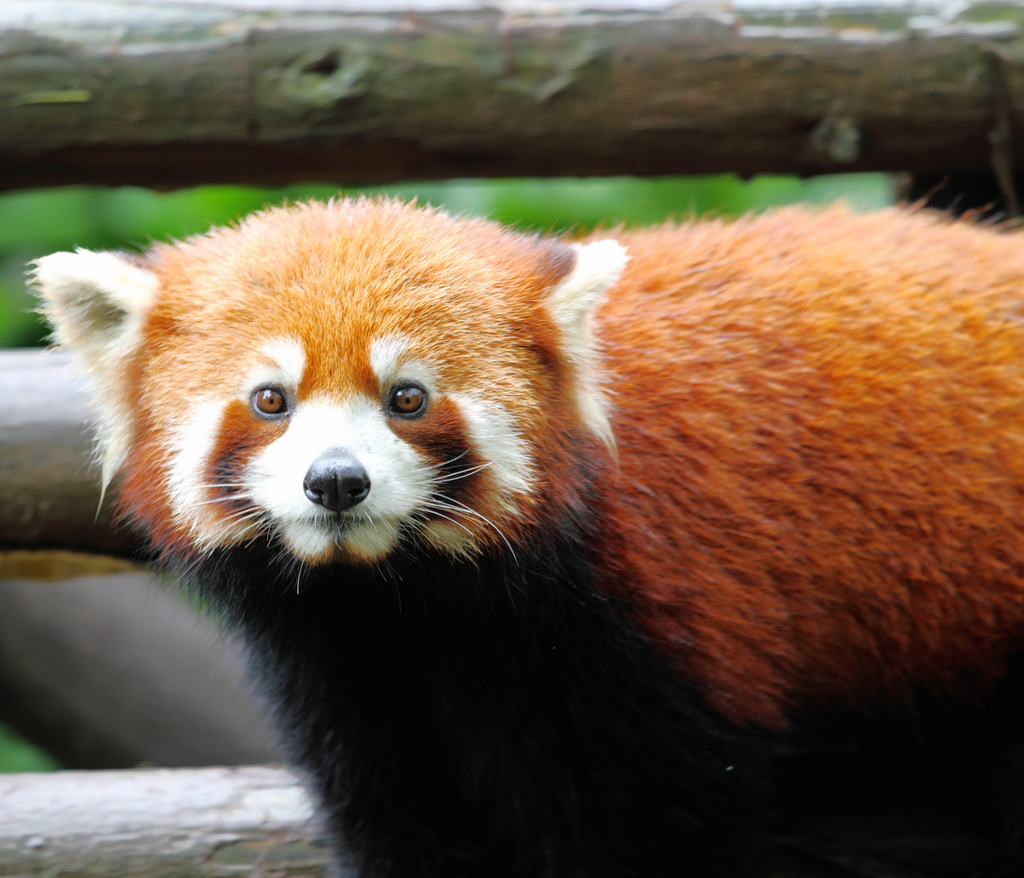
The Red Panda is a raccoon-like animal native to China’s southwest border with the Himalayas—which also borders Nepal, India, Bhutan and Myanmar (Burma). Living in the ‘Roof of the World’, Red Pandas require colder temperatures to be comfortable (between 17 and 25°C).

Flickr photo by Kenneth Barrett

Flickr photo by "afagen"
You’ve probably seen pictures and videos of Red Pandas recently in the Internet—resembling plump reddish brown raccoons but are playful like Giant Panda cubs. The Red Panda has been popularized in recent years by the Mozilla Firefox browser (although the Firefox logo is a red fox, not a red panda), and by the Kung Fu Panda movies as Master Shifu, the Kung Fu teacher of Po, Jack Black’s giant panda character.
Even though the Red Panda and the Giant Panda are not close relatives, they surprisingly share some characteristics.
  • Both live in similar cold places (although their territories don’t overlap—the Giant Panda lives in the mountains of Central China).
  • Both eat mostly bamboo (although both will supplement their diet—with other leaves, fruits, berries, birds’ eggs—even meat—whenever available).
  • Both have false ‘thumbs’ (actually an overgrown wrist bone)—for the Red Panda, to aid in climbing trees; for the Giant Panda, as an aid in grasping bamboos.
  • Both are recognized as “living fossils.”
These shared characteristics are probably the reason why the two pandas were seen as relatives at first, the Red Panda being discovered 48 years earlier than the Giant Panda. Nowadays, modern molecular genetic and classification techniques have identified the Red Panda as the sole representative of its own family group, the Ailuridae—it’s scientific name, Ailurus fulgens—“shining cat.” Meanwhile, the Giant Panda is now rightly recognized as a true bear (family Ursidae), but still shares a similar looking genus in its scientific name: Ailuropoda melanoleuca “black-and-white cat-foot.”

Flickr photo by Frank Peters

Flickr photo by "ksbuehler"

Flickr photo by "Light Knight"

Unlike the Giant Panda, (which is very difficult to breed inside zoos), the Red Panda readily breeds in captivity.

While the Red Panda can be domesticated as a pet (there doesn’t seem to be any concerted efforts to do just this as of the moment), providing it with both bamboo and the cold temperatures it needs would not be easy for ordinary homes in the US and Europe—plus getting one into these countries would be difficult because of the Red Panda’s endangered status. But, for its survival, domestication might be the most viable option.

Monday, April 11, 2011